Reflection by: Sem. Rhexelle Andrei Abdon
There is something beautiful about a seed.
A seed never chooses the hand that scatters it. It does not choose which ground it will finally fall. It cannot complain if it falls on rich soil or rough ground. A seed simply goes, if fortunate grows where it is scattered.
That said, a reality of life which we cannot escape.
In the language of Martin Heidegger, his notion of Geworfenheit, or “thrownness,” in Being and Time. It describes how humans are involuntarily “thrown” into the world.
Meaning, none of us chose the family into which we were born. We did not choose the generation we belong to. Many of us did not choose our human limitations, our illnesses, or the struggles of this life—we did not choose most of the circumstances that accompany us every day. Yet so often, we spend our lives arguing with this reality. We look at our circumstances and think:
“If only I had a different family… if only I had a better job… if only I were healthier… if only life were less complicated… sana hindi ako ipinanganak ng ganito..then I could truly become the person God wants me to be.”
We cannot choose where we are scattered.
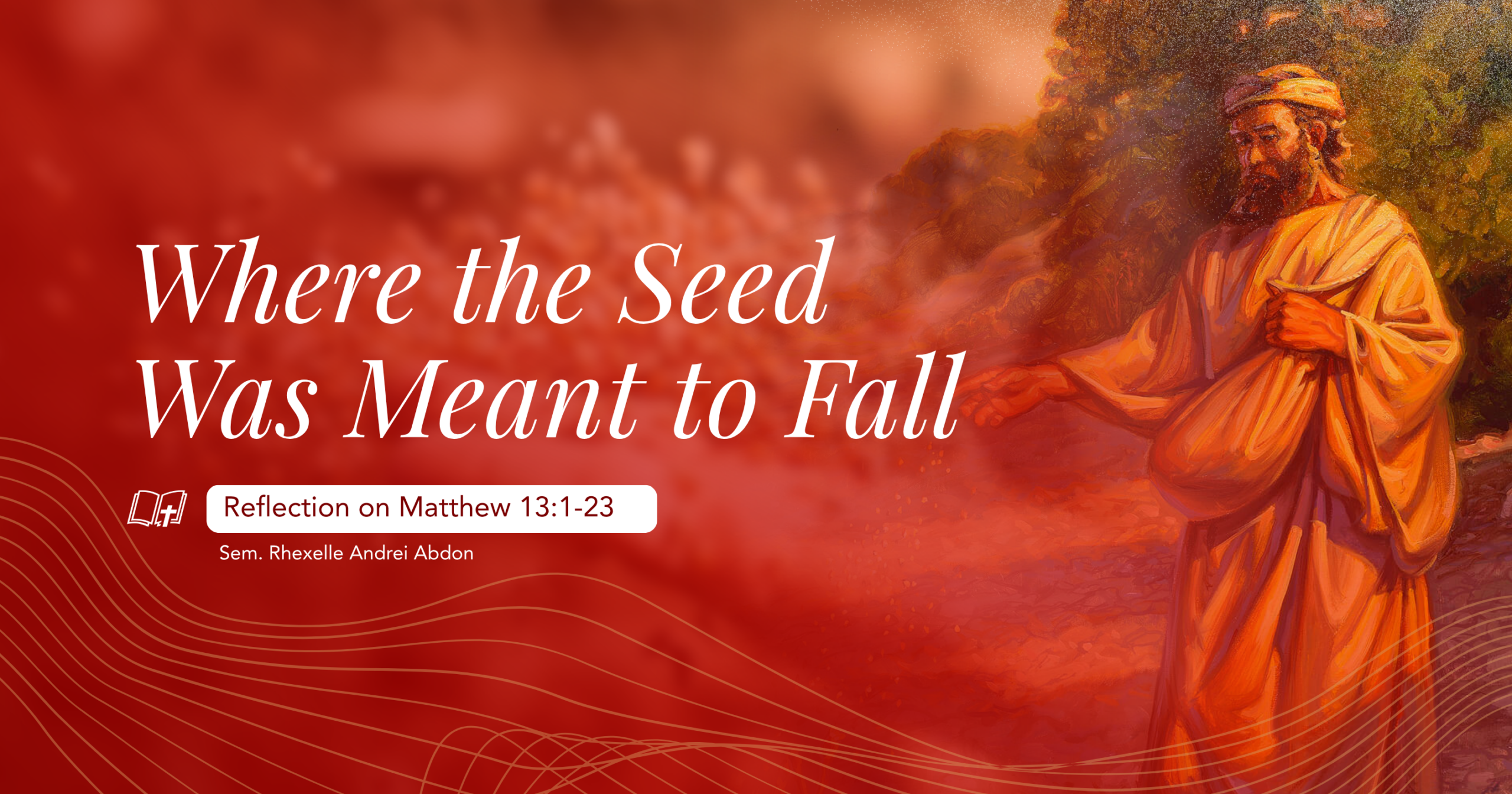
In tomorrow’s gospel episode, Jesus sits by the shore and tells the people the Parable of the Sower. A farmer scattering seeds that land on four types of ground. Some falls along the path and are eaten by birds. Some fall on rocky ground, spring up quickly, but dies under the heat because it has no deep roots. Some fall among thorns and are choked. Finally, some fall on good soil and bears fruit—a hundredfold, sixtyfold, thirtyfold.
Usually, the conventional perspective on this parable is that the seed is word of God and we are soils of different kinds, so we look and examine ourselves, “What kind of soil am I?” We begin examining every weakness and every failure. We often conclude that we must remove every stone, uprooting every thorn, hardening ourselves against all odds until we finally become “good soil.” Which I believe is also true, we are called to grow.
But if that is our premise, we risk reducing the Gospel to mere self-improvement project. We begin believing that God can only work in us once we have fixed (ed) ourselves.
Now, there is a beautiful perspective to this parable written by Fr. Thomas Green in the preface on one of his books, which I think, a more consoling eye that cohere with our human realities.
He said, to make sense the parable, if must continue reading Matthew’s Gospel, Jesus immediately tells another parable—the wheat and the weeds. The servants notice weeds growing among the wheat and immediately ask the master whether they should pull them out. Surprisingly, the master tells them not to pull the weeds. Why? Because the roots of the weeds have already intertwined with the wheat. To uproot one is to endanger the other.
Fr. Green applies this image to our own spiritual lives.
There is no such thing as a dual world of black and white.
Most of our human experiences are full of GRAY areas. Grace and weakness often grow in the same heart. If there is Faith, then there must be doubt. In every Generosity there is also selfishness. Hope exists because there is fear. The reality of Love of God and the lingering effects of sin.
Our hearts are rarely a perfectly cultivated field. More often, they are a mixture of good seeds and weeds, fertile soil and rocky ground, open spaces, and hidden thorns.
Meaning, we are imperfect human thrown in to this imperfect world.
Why? I dont really know. Experience teaches that our sins and weaknesses cannot be completely eliminated, even though we must continually struggle against them. God patiently allows other seeds fell on rough grounds or the wheat and the weeds to grow together until the end, revealing His mercy and calling us to extend the same patience to ourselves and others. Thus, Christians are called to live faithfully in a world where both good and evil coexist.
I think this is a message we desperately need today—to acknowledge this reality.
Because most of time live we in what Byung-Chul Han calls the culture of positivity. Ours is a world that constantly tells us to become better versions of ourselves—to be more productive, to be more efficient, to be more successful, to be more attractive, and more accomplished.
Brothers, even our spiritual lives, can become infected by this mentality.
We become impatient with ourselves. We become frustrated because we still struggle with the same sins again and again. We become disappointed because our prayer cannot reach God. We think that unless we eliminate every weakness, God will never be pleased. We neglect to acknowledge negativity that makes life even more beautiful.
Without realizing it, we begin treating ourselves with this violence of positivity.
We become angry at our own soil. We resent ourselves, family and circumstance. We despise the things that make us human.
But the Gospel presents us with who truly God is.
He is the patient Sower.
He knows exactly where His seed has fallen.
Most of the time we ask God many questions which we fail to get the answer.
As Fr. Norman said,
“If you cannot answer the question, maybe change the question.”
Perhaps we have been asking the wrong question.
Instead of asking whether our soil is good enough, perhaps we should first ask whether we really trust the Sower who scatters the seed.
I believe we must learn to bloom where we have been scattered. Grow where you are planted.
You do not choose your birth era, culture, family, or circumstances, we must navigate and build meaning within these uncontrollable bounds.
We may find ourselves on the pathway, or among the rocks, or we may feel surrounded by thorns.
In my case, I have been destined for this particular circumstance: this imperfect family, this unique identity, this physically inadequate yet strong-willed body. These are the very realities that have shaped me into the Rhexelle I am today.
Living in this limited human and existing in this finite world, make us question may things, but as Nietzsche said:
“He who has a why to live can bear almost any how.”
The “how” of our lives may be difficult. Perhaps our “how” is illness. Perhaps it is loneliness. Perhaps it is failure. Perhaps it is a family situation you have never asked for. Perhaps it is a cross you would never have chosen.
But our “why” has already been given to us.
Our why is ultimately Christ.
And when Christ becomes our reason for living, there is not such thing as difficult ground.
My brothers, reality urge us to acknowledge this reality:
You did not choose where you were scattered.
But the Sower did.
It does not mean that he is a reckless and lazy Sower, it means that he purposely scatters us in this our particulate circumstances. He entrusted you to this family, this community, this body, this vocation, this moment in history—not by accident, but by love.
The field may not be perfect. Your heart may still contain rocks and thorns. There may still be weeds growing alongside the seed. Yet none of these prevent the Sower from continuing His work.
May we learn, then, not to spend our lives arguing with the ground beneath our feet, but to trust the hands that scattered us here.
For the One who planted us is also the One who will bring His harvest to completion.
Jean-Paul Sarte is wrong. We are not DOOMED into this world. Instead, we are destined to be in this world.
Amen.

By Rhexelle Andrei Abdon
Rhexelle Andrei Abdon is a third-year AB Philosophy student at Saint Paul Seminary Foundation, discerning his vocation with the Society of St. Paul.