Reflection by Sem. Restituto Manatad III
The hardest part of life is not making the wrong decision; it is having the chance to make it right but refusing to do so.
Every one of us has made decisions in life. Some are small and ordinary, while others completely change the direction of our lives. Some decisions bring us joy, while others leave us with regret.
I believe that whenever we make a decision, life gives us two gifts: reward and consequence.
A reward is the joy, peace, and fulfillment that come from making the right decision. It reminds us that choosing what is good always bears good fruit.
A consequence, on the other hand, is what we receive after making the wrong decision. We often think of consequences as something negative, but I also see them as lessons. They teach us to become wiser, humbler, and more careful the next time we are faced with a choice.
My dear brothers, today’s Gospel presents to us a man who made one decision that he would regret for the rest of his life.
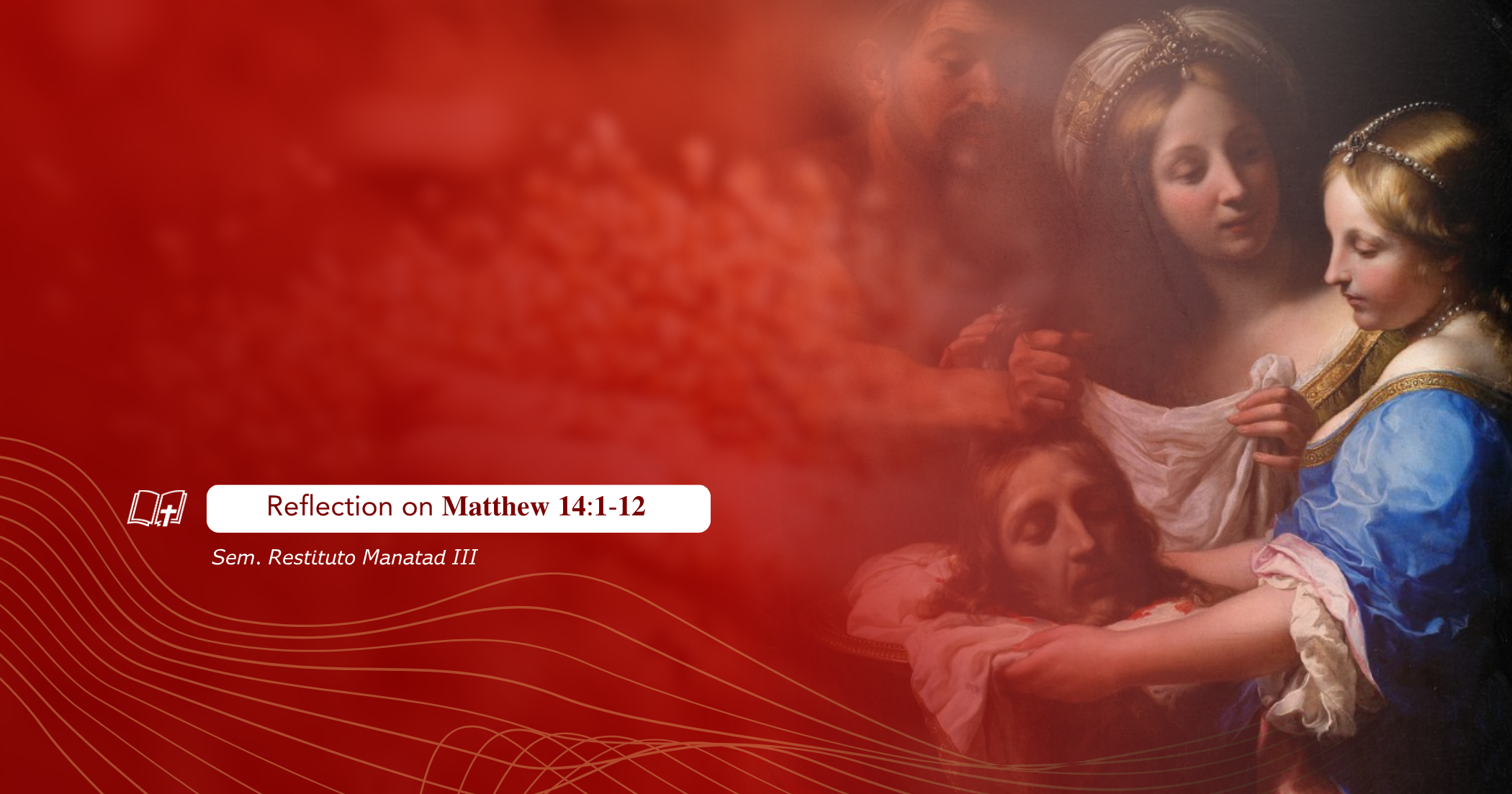
King Herod was delighted by the dance of Herodias’ daughter. Out of excitement and impulse, he made a reckless promise. He swore before everyone that he would grant whatever she asked, even if it meant giving away half of his kingdom.
Personally, I don’t think Herod intended to kill John the Baptist. I think he was simply trying to be generous because he was pleased with the girl’s performance. But Herodias, who had long hated John because he spoke the truth about her unlawful marriage, saw this as the perfect opportunity. She instructed her daughter to ask for the head of John the Baptist.
At that very moment, Herod had a choice.
In the story it tells us that he was distressed. He knew what was right. He knew John was innocent. He had the chance to correct his mistake.
But instead of choosing what was right, he chose to protect his reputation. He was more afraid of embarrassing himself before his guests than of taking the life of an innocent man.
The hardest part of life is not making the wrong decision; it is having the chance to make it right but refusing to do so.
My dear brothers, we make decisions every single day. Most of the time, we don’t even notice them because they seem so small. We tell ourselves, “It’s just a little thing.” But little decisions slowly shape our character.
For instance, being late.
Sometimes we think it’s not a big deal because we have reasons. Maybe because of traffic, maybe we overslept, maybe we were finishing something important. But behind our lateness is another reality that we fail to respect the time and effort of those who made it a priority to arrive on time.
Or when we promise a brother that we will help him with something. But when the time comes, we forget, or become busy, that we forget show up. It may seem like a small decision, but broken promises slowly weaken trust.
Or even something as simple as borrowing or using an item. We tell ourselves that we will return it to where we got it, but because we become occupied with other things, we leave it somewhere else. We may not intend to cause inconvenience, but someone else must spend time looking for it.
These seem like ordinary decisions, yet they reveal the kind of person we are becoming.
Now let us look at the bigger picture.
Why did you decide to enter the seminary?
Was it a decision results of contemplation and discernment? Or was it simply out of curiosity, to see what seminary life is like?
If you just try out of curiosity, are you ready to face the consequences of it? Or are you regretting it now that you enter and wanted to go out already?
To be honest, my dear brothers and fathers, as I have shared with many of you before, I never expected to enter this seminary.
I honestly thought the examination I took was for the diocesan seminary. The priest in our local parish, in the place where I used to work, kept encouraging me to return and take the entrance examination. Out of respect for him, I agreed. At that point in my life, I honestly didn’t care whether I passed or failed. I simply wanted to honor his request.
After the examination came the interview.
That was when I realized I wasn’t applying to a diocesan seminary at all—it was a religious congregation. During the interview, Father Samy asked me where I first learned about the Society of Saint Paul.
I answered, “Father, to be honest, I don’t even know your congregation.”
But the hardest part is after I learned that I had passed.
That became one of the hardest decisions of my life.
Should I enter the seminary, or should I continue the life I already had?
At that time, I had also passed the entrance examination for Mechanical Engineering. I already had a stable job. I had a very kind employer, my madam who genuinely supported my education.
Humanly speaking, I already had a clear path ahead of me.
So, I was torn.
Should I stay with the life that already seemed secure, or should I leave everything behind for new beginning of my life?
In my prayer, I challenged the Lord.
I said, “Lord, if You truly want me here, then You provide everything I need. Even the material things that I cannot afford.”
A week before my entrance, something astonishing happened.
Without me asking, everything was already prepared.
My clothes. My documents. My transportation. Even my plane ticket.
My madam had quietly prepared everything without telling me.
At that moment, I realized that perhaps this decision was no longer mine alone. God had already begun opening the doors before I even had the courage to walk through them.
That is why I entered.
I am not saying this because I regret entering the seminary. In fact, I thank God every day for bringing me here. I simply share this as an example that whenever we make a decision, we should also be fully aware of the gifts that come with it. Every decision carry either a reward or a consequence. If we choose wisely, we receive the reward that comes from doing what is right. If we choose poorly, we must also be willing to accept the consequences not as something to fear, but as an opportunity to grow and learn.
Looking back, I have no regrets about entering the seminary. It has not always been easy, but every challenge has taught me something about myself, about my vocation, and about God’s faithfulness. It reminded me that making a decision is only the beginning; remaining faithful to that decision every single day is the greater challenge.
Then I realize that life is full of decisions. Some become blessings, while others become lessons. But the Gospel reminds us of something even more important.
Making the wrong decision does not always define us. What truly defines us is what we do when God gives us the opportunity to make things right.
Herod had that opportunity, but he chose his pride. May we never make the same mistake.
Whenever God gives us another chance to choose what is true, what is good, and what is right, may we have the courage to choose Him over our pride, our fear, and the opinions of others.
Amen.

By Gerick Tolentino
𝗔 𝗳𝗶𝗿𝘀𝘁-𝘆𝗲𝗮𝗿 𝗔𝗕 𝗣𝗵𝗶𝗹𝗼𝘀𝗼𝗽𝗵𝘆 𝘀𝘁𝘂𝗱𝗲𝗻𝘁 and aspirant of the 𝗦𝗼𝗰𝗶𝗲𝘁𝘆 𝗼𝗳 𝗦𝗮𝗶𝗻𝘁 𝗣𝗮𝘂𝗹.