Buona sera, miei cari fratelli e sorelle.
As children, we looked at the stars and believed they were reachable. We pointed at airplanes and wondered what it felt like to leave. We watched birds disappear into the horizon and somehow thought that growing up meant becoming like them—free, unbound, capable of going somewhere far beyond the places that first named us.
Perhaps that is why dreams have always been associated with the sky.
The sky is vast. It has no visible borders, no fences. It invites us to imagine possibilities. It teaches us that there is always something beyond what our eyes can presently see.
Dream bigger. Aim higher. Reach further. Look at the sky.
I have always been fascinated by the thought:
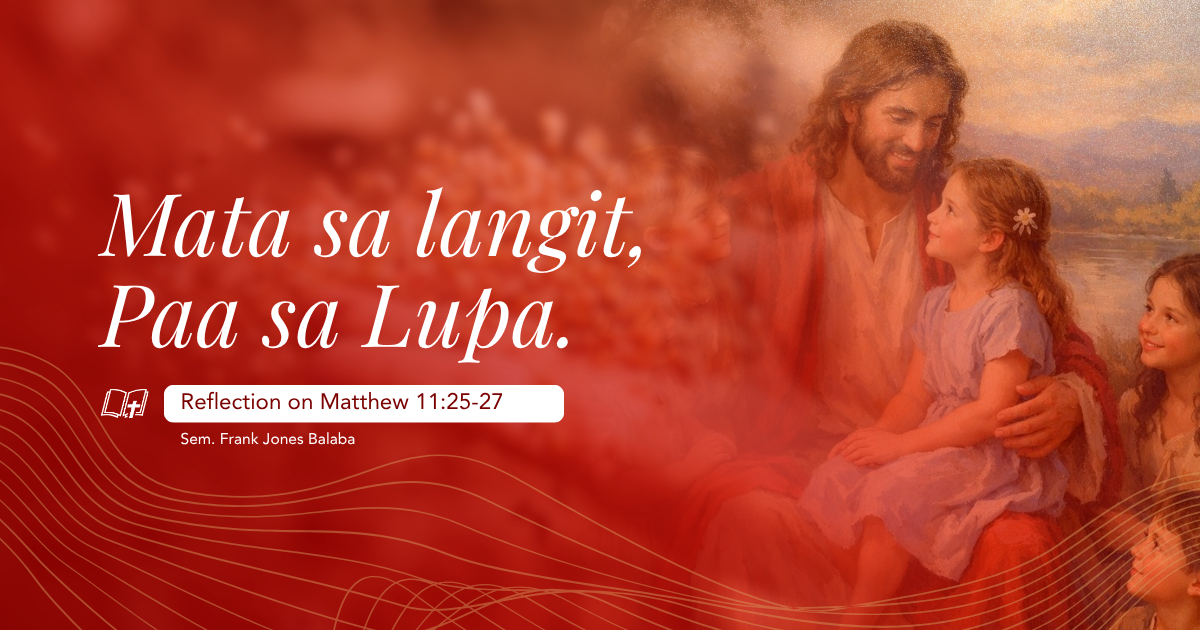
“Mata sa langit, Paa sa lupa.”
To look at the sky is to acknowledge that life can still become something more.
But to keep one’s feet on the ground is to remember that we remain human.
We human beings are a synthesis of the finite and the infinite.
We are creatures suspended between two realities.
Part of us longs for eternity, greatness, and transcendence. We want our lives to mean something. We wish to leave marks upon the world.
Yet another part of us remains painfully finite.
Napapagod tayo, we fail, we grieve, we lose people, and we doubt ourselves.
No matter how grand our ambitions become, we remain vulnerable creatures.
Tao lang.
In a song by Loonie, there is a line that says:
“Kahit anong taas mo na, titingala ka pa rin.”
Because there will always be another sky. Another dream. Another horizon. Another mountain.
No matter how high a person rises, there will always remain something greater than himself.
A truth that should not depress us but humble us.
This is precisely where the Gospel meets our human condition.
Because the more we realize how vast the sky is and how limited we are, the more we understand why Jesus praises not the self-sufficient, but the little ones.
I praise you, Father, Lord of heaven and earth, because although you have hidden these things from the wise and learned, you have revealed them to little children.
It seems that Jesus is praising ignorance over wisdom.
But I believe that is not what Christ meant.
Rather, He was speaking of humility.
The “wise and learned” are those who have become so convinced of their own knowledge, accomplishments, and importance that they no longer have room for wonder, no longer have room for dependence, and perhaps no longer have room for God.
Meanwhile, the “little children” are those who remain open, receptive, and aware that despite everything they know, there remains infinitely more that they do not know.
“Paa sa lupa.”
To remain little before God.
To remain aware that our achievements do not make us self-sufficient. To remain aware that every blessing, every opportunity, every success is ultimately grace.
Perhaps this childlike humility is what allows us to keep our eyes fixed on heaven without forgetting that we are still pilgrims on earth.
One thing I learned in the Society of Saint Paul:
Tingin sa langit.
Look upward. Dream higher. Hope for greater things.
Aspire for holiness.
We did not enter the seminary merely to earn degrees or titles.
We entered because somewhere within us, there was a longing for something beyond ourselves.
A longing for God. A longing to serve. A longing to become more. A longing for heaven.
Because the Gospel does not ask us to stop dreaming. Rather, it purifies our dreams.
As seminarians, we are called to dream greatly—not worldly dreams of prestige and recognition, but the dream of becoming holy priests and faithful servants.
As Saint Paul would say:
“Siate miei imitatori, come io sono di Cristo.”
Be imitators of me as I am of Christ.
We are called to be imitators of Christ.
To become another Christ.
To allow ourselves to be transformed by grace. To become men whose hearts beat in rhythm with the heart of the Good Shepherd.
But while our eyes are fixed upon heaven, the Gospel also reminds us:
Paa sa lupa. Remain humble. Remain childlike. Remain grateful.
Knowledge can become pride. Positions can become pride. Apostolate can become pride.
One can speak about God and yet slowly forget dependence on God. One can dream of serving others and yet begin to serve oneself.
And so Christ reminds us that the mysteries of God are revealed not to those who think they have already arrived, but to those who remain little.
To those who still know how to kneel. To those who still know how to listen. To those who still know how to wonder.
And perhaps this call to remain both heaven-oriented and childlike is something I have slowly learned during these years in formation.
It has already been three years since I stepped beyond the familiar boundaries of Balingasag.
Three years since I first learned that leaving home is not merely about distance.
Because leaving home is, in many ways, an act of death.
A quiet and gradual one. You die to certain routines, certain friendships, certain versions of yourself.
You learn that the world does not stop simply because you have left it.
Heraclitus once said that no man ever steps into the same river twice.
Perhaps the same can be said of home.
You may return to it, but it will never be exactly as you left it.
And neither will you.
Leaving home is about becoming.
And these past three years have become years of becoming.
Years of joy and loneliness. Years of victories and failures.
Years of certainty and doubt. Years of learning not only who I am, but also who I am not.
Three years later, I have experienced victories that once seemed impossible.
I have also endured failures that humbled me. There were days filled with hope and nights heavy with loneliness. Moments when I questioned whether I was walking the right path.
Moments when I wondered if dreams were worth the cost of leaving.
In those moments, I began to understand why Jesus speaks of becoming like little children. Because only those who know how to trust can continue walking despite uncertainty.
And perhaps this is also the beauty of seminary life.
Because we do not walk this journey alone. The soil beneath our feet is shared. Our brothers walk beside us. Our formators journey with us. The Church accompanies us. Community life reminds us that holiness is never achieved in isolation.
We pray together. We study together. We laugh together. We struggle together.
And by God’s grace, we rise together.
“Paa sa lupa.”
To remember that our feet stand on the same ground as our brothers.
That before we are future priests, leaders, or ministers, we are first companions.
Fellow pilgrims. Children of the same Father.
And maybe this is why Jesus praises the little ones.
Because children know that they cannot walk alone. Children know how to trust. Children know how to depend. Children know how to receive.
Perhaps this is the lesson these three years have taught me.
To continue looking toward heaven. To continue dreaming. To continue hoping. To continue becoming.
But also—
To remain grateful. To remain humble. To remember my roots. To cherish my brothers. To value community. To recognize that everything is grace.
The Father reveals Himself not to those who think they have already arrived, but to those who continue to walk as children, eyes fixed on heaven, feet firmly planted on the earth.
Tingin sa langit.
For our hearts were made for heaven.
Paa sa lupa.
For we remain pilgrims, servants, brothers, and children before God.
We spend our entire lives looking upward, reaching for something greater than ourselves, while carrying on our feet the dust of the places that first taught us how to dream.
And maybe this is also the beauty of the Christian life.
To spend our lives looking toward heaven while walking humbly upon the earth, hand in hand with our brothers, until all our dreams, all our journeys, and all our becoming finally lead us back to the Father, whom Jesus calls the Lord of heaven and earth.

By Jan Ernest Pàting
A second-year AB Philosophy student and aspirant of the Society of Saint Paul. He is currently discerning his vocation to the religious life inspired by the footsteps of the great apostle Paul.